
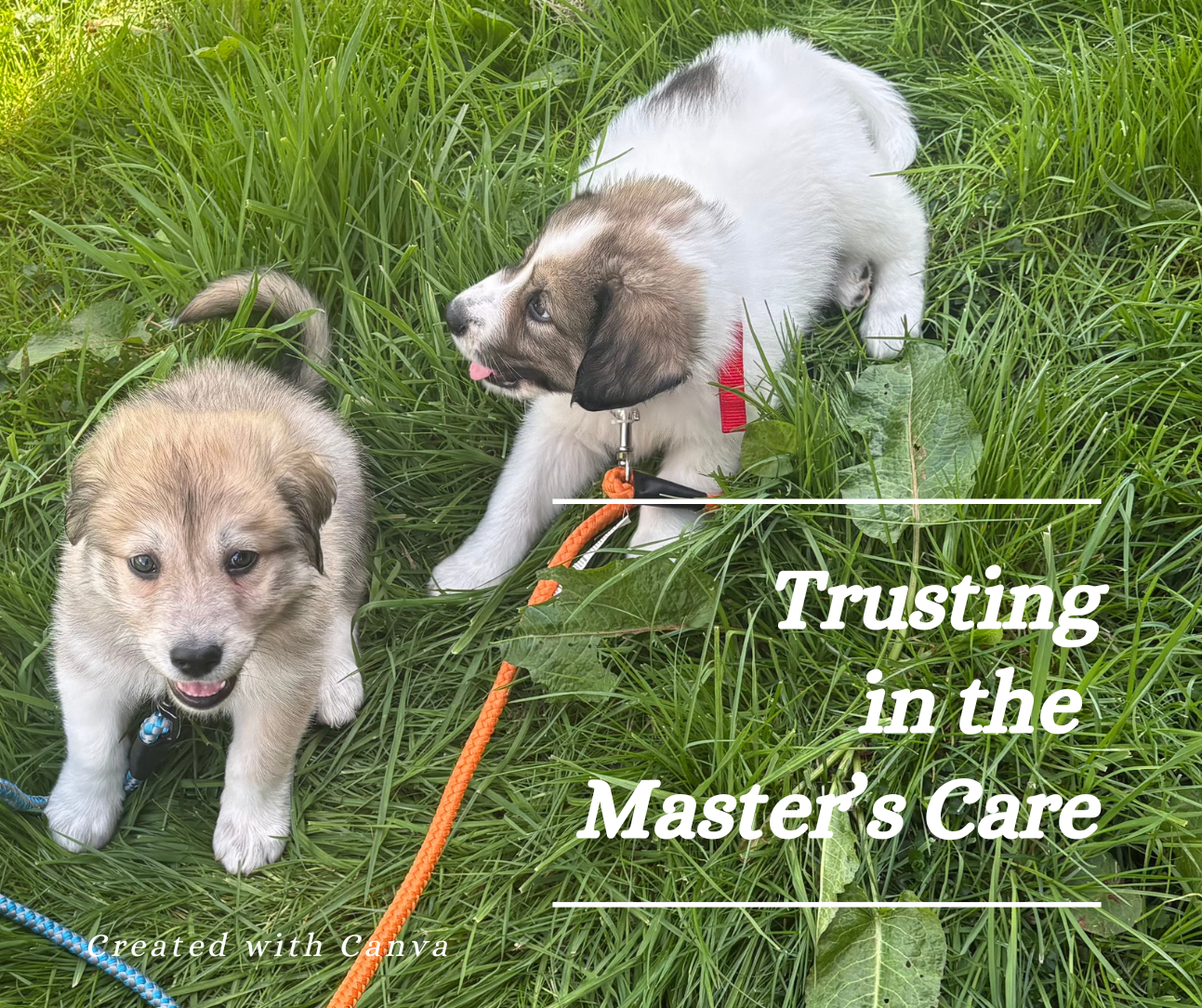
My husband and I recently adopted two puppies from a local humane society. Sounds a bit crazy, I know. But these dogs are a Pyrenees Anatolian Shepherd mix—breeds historically recognized as livestock guardians. At the time, it didn’t matter that neither my husband nor I knew a thing about training guardian dogs. We chose to bring male and female littermates home anyway since we plan to add goats to our farm soon. Keeping the livestock safe is our top priority.

So, I researched into local people who had experience training livestock guardian dogs and found a place not too far from us. As the crow flies, the trainer was located only 13 miles away. But anyone who’s spent time in Appalachia knows to double that number when actually driving to a location in the mountains.
As I wove my way along the winding route on our 40-minute trek, my pups cried out in their crate. They were having trouble trusting in the master’s care—who unfortunately happened to be me. I couldn’t blame them. The only time they’d ridden in a car was when we brought them home from the shelter and I’m sure the hairpin turns on this trip were frightening.
All the while, I tried to reassure them by speaking in a calm voice, playing music on the radio, and even singing. This last tactic always worked with the grandkids when they were upset. But this time, my off-key voice did nothing to dissuade my dogs’ fears.
As I listened to their whining, I couldn’t help but compare my own reaction to the unknown to that of my dogs. Like my puppies, I often struggle trusting in the Master’s care. I say I believe God is a good and loving Father who only has my best interest at heart. So, why do I still have anxiety about the future? I profess God as the Master of my life and Jesus as my Savior. But I reveal a lack of genuine trust when I worry and fret over events which may or may not even happen.

My puppies had no way of looking ahead during our journey. Their crate was positioned in the back of my car, so they only could see to the side and out the rear window. In the same way, human beings have singular views of the past as well as the present. None of us are privy to the future with the exception of a limited number of Biblical prophets. Then how are we to have the confidence to follow Jesus’ directive in the Sermon on the Mount?
Therefore, I tell you, do not worry about your life, what you will eat or what you will drink, or about your body, what you will wear. Is not life more than food and the body more than clothing? Look at the birds of the air. They neither sow nor reap nor gather into barns, and yet your heavenly Father feeds them. Are you not of more value than they?
The words of Jesus from Matthew 6:25-26 NRSVUE

At first, this command appears impossible to follow. Wouldn’t it be irresponsible to disregard your basic needs if you had the power to provide them for yourself? If taken literally, Jesus’ statement doesn’t make sense. However, I don’t believe having a laisse-faire attitude toward self-care was Jesus’ point.
Trusting in the Master’s care is more about the correct placement of our focus than it is about denying ourselves essential necessities. A little further in the scripture, Jesus explains.
. . . indeed, your heavenly Father knows that you need all these things. But seek first the kingdom of God and His righteousness, and all these things will be given to you as well.
Matthew 6:32-33 NRSVUE
When we turn our attention toward loving God, caring for others and His kingdom, we naturally take the focus off ourselves. Of course, we must maintain some self-care. If we neglect our own wellbeing, we will be no good to others. But don’t allow self-promotion to become all-consuming or it will become destructive to your soul.
Fixing our minds on God and others rather than solely on ourselves, certainly decreases our worry about the future. Yet without some history in the Master’s care, we still may suffer with anxiety.

I shouldn’t expect less from my pups. They don’t have any memory of drives to fun places or knowledge of safe returns back to the farm. My husband and I have no history with them yet. Over time I expect they’ll look forward with joy instead of fear when we load them in their crate for a car ride. But we must build their trust. It doesn’t come naturally.
Likewise, remembrance of the times God has blessed me and walked with me through hard places, helps alleviate my worries. Trusting in the Master’s care for my future comes through repeated experiences of His loving kindness toward me from the past. When I look back on my journey with the Lord and recall His faithfulness at every turn, this knowledge enables me to move forward with courage.
Building trust develops little by little. It takes focus and a shared history to achieve. I’m willing to invest in my new puppies as God does in me to gain their trust. I have confidence that someday they will develop a similar kind of assurance with me as I do with my heavenly Father—certainly not perfect—but real.

But blessed is the one who trusts in the LORD, whose confidence is in him. They will be like a tree planted by the water that sends out its roots by the stream. It does not fear when heat comes; its leaves are always green. It has no worries in a year of drought and never fails to bear fruit.
Jeremiah 17:7-8 NIV




One response to “Trusting In the Master’s Care”
The puppies are adorable, Suzanne, and you have shared a powerful parable here.